



How to calculate the ideal number of guests for your wedding
One of the first decisions that comes up when you start planning a wedding is also one of the most difficult: how many guests should we invite?
It’s not just a matter of numbers or relationships. The number of guests determines the space, the budget and, ultimately, how the celebration is experienced.
That’s why, rather than looking for a perfect number, it’s worth asking which number of guests best fits the kind of wedding you have in mind. Because there is no universally correct number, but rather a number that is coherent with the way you want to celebrate this day.
Key factors for calculating the ideal number of guests
Before settling on a final number, there are a few factors worth being clear about. It’s less about adding up names and more about understanding what kind of wedding you want and the decisions that come with it.
Budget: how the number of guests affects it
The number of guests has a direct impact on the wedding budget. As the guest list grows, so do the associated costs: catering, staff, furniture, logistics and services.
With a smaller number of guests, there is often more room to take care of details and invest in quality, such as a more thoughtfully designed menu, a better wine selection or even a longer celebration. With a larger wedding, on the other hand, it’s necessary to assume a bigger structure and carefully prioritise where the budget is allocated.
Venue: adapting the number of guests to the space
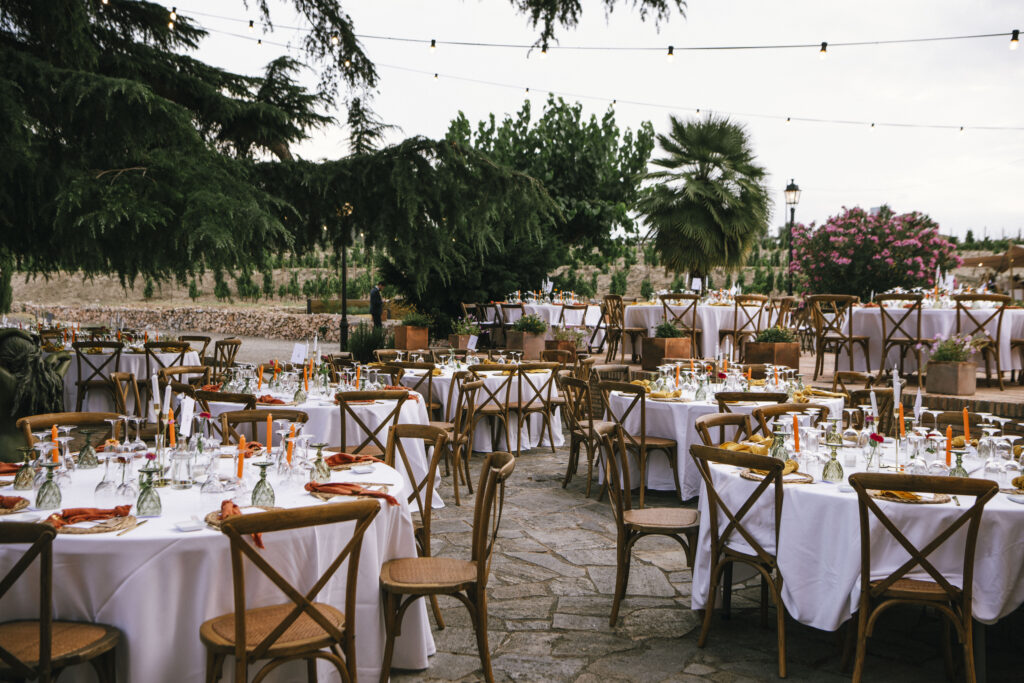
Not all venues work equally well with any number of guests. The same place can feel welcoming with an intimate format and lose that balance if the volume of guests is excessive.
Thinking about the venue from the beginning helps adjust the number of guests realistically, ensuring comfort, flow and a good experience for both the couple and their guests, while avoiding spaces that feel either too tight or, on the contrary, empty.
Type of celebration: which format represents you
The number of guests is also directly related to the type of celebration you want. An intimate wedding allows for a calmer pace and moments shared without rushing. A medium-sized format usually seeks a balance between atmosphere and energy. A large wedding requires a more structured organisation and careful time management.
No option is better than another, but each one works best with a specific number of guests.
Pace and logistics: how the day unfolds
As the number of guests increases, the complexity of the organisation increases as well. More travel, more coordination and less room for improvisation.
In practice, this affects very concrete aspects such as the time needed to serve the aperitif, the length of the banquet or the management of transport — elements that change significantly depending on the number of people and ultimately define the real pace of the day.
It’s also important to keep in mind that the number of guests can greatly simplify or complicate the organisation of a wedding. As the list grows, so does the workload and the likelihood of unexpected issues arising.

Reaching the right number
Calculating the ideal number of guests is not a mathematical decision, but a matter of coherence. When the number fits the venue, the budget and the type of celebration, everything flows more naturally.
Rather than asking how many guests a wedding should have, the key question is how many guests make your wedding feel the way you imagine it.
If you have doubts about the number of guests or the format of your wedding, you can contact us and we’ll help you clarify it.